
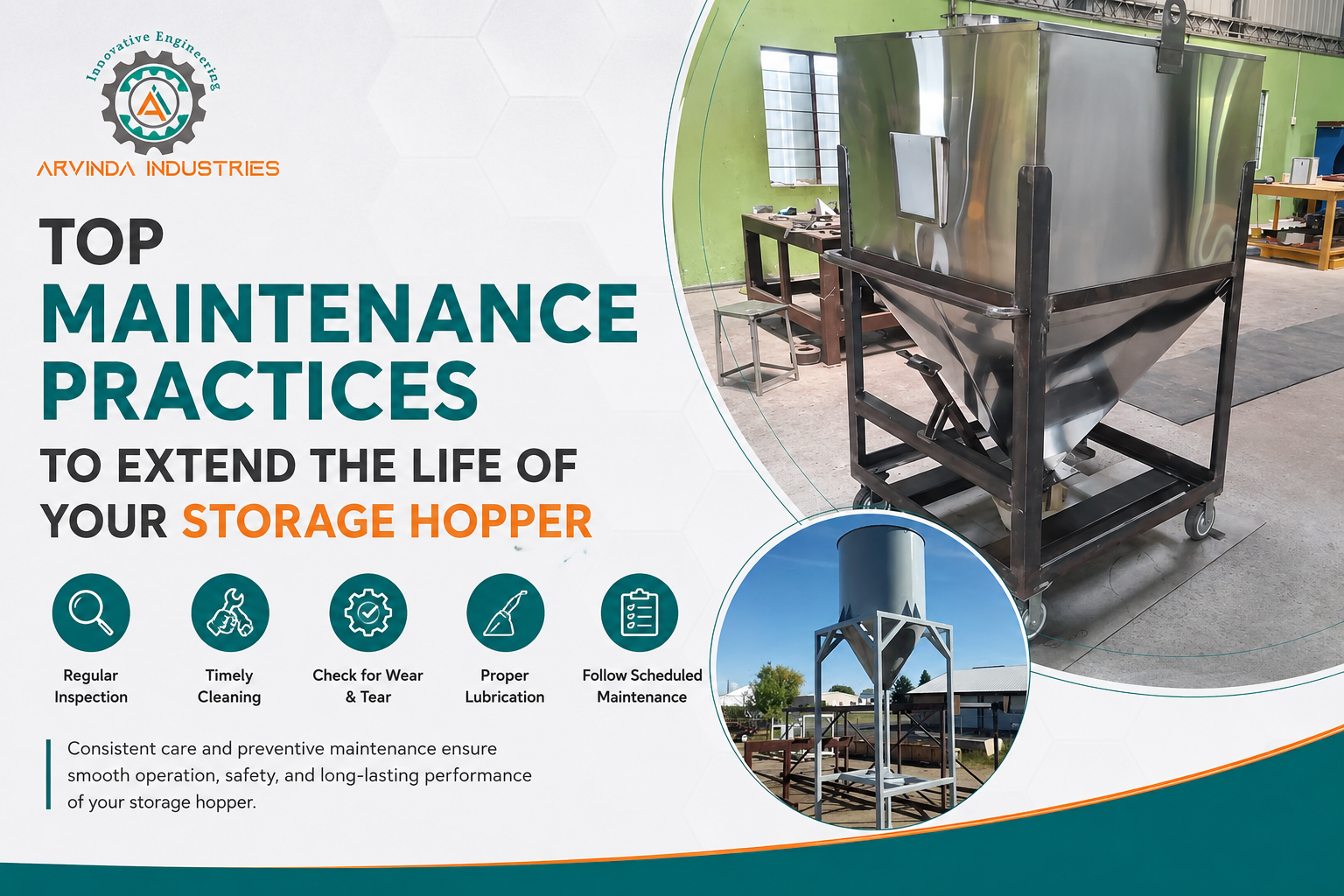
But over time, abrasive, heavy, or moisture-sensitive bulk materials cause severe wear and tear on hoppers. If you do not proactively care for your systems, you could suffer from problems with materials and flow, structural damage, or expensive downtime.
Arvinda Industries is one of the prominent storage hopper manufacturers in India that manufactures industrial-grade containers for long usage. We have compiled the top 7 maintenance practices, to help you get the best life from your storage hopper to maximise your investment.
Top 7 Maintenance Practices to Extend the Life of Your Storage Hopper
1. Implement Routine Visual Inspections
The key to prevention is constant surveillance. Create a weekly or monthly plan to visually monitor the hopper body, support structures and the pyramid-shaped bottom cone. Watch for the following early signs of:
- Structural deformation: Any visible signs of bending or buckling under load stresses.
- Rust and Corrosion: Look closely for paint peeling, particularly on mild carbon steel surfaces exposed to atmospheric humidity.
- Weld Wear: Inspect structural weld joints for small hairline fractures or stressed areas.
Cracks or surface rust are better identified at an early stage and can be avoided from becoming catastrophic structural issues.
2. Check and Maintain Discharge Gates and Valves
One of the most active mechanical parts of the hopper is the discharge mechanism (whether it be a butterfly valve, knife edge gate valve or a rotary air lock valve).
- Remove built up powders or granules that may block the gates.
- Lubricate moving parts and actuators according to manufacturer's instructions.
- Replace worn-out seals promptly to avoid leakage of material and dust emissions.
These flow control devices help to provide a smooth and regulated flow of the discharge every time.
3. Keep the Ventilation and Filtration Systems Clean
High-quality storage hoppers have ventilation systems to control the temperature and moisture inside the hopper. Water in a hopper spells trouble, as it causes caking of material, clumping and hastens corrosion that occurs within the belly of the hopper.
- Clean vent filters regularly and inspect them systematically.
- Make sure there is a good seal on the rooftop lid to keep the rainwater/snow out.
- Check for obstructions on air vents which allow for a free balance of pressure during filling and discharging.
4. Clear Material Build-up (Prevent "Rat-Holing" and Bridging)
Coherent powders or wettish substances are more prone to adhering to walls of the hopper which may cause bridging or "rat-holing." This stagnant material can grow hard over time, absorb moisture and corrode the contact parts, including stainless steel (AISI 304 or 316) as time goes by.
- Regularly flush out the hopper to clear any stagnant materials.
- Test the performance of flow aids (bin vibrators or aeration pads) to ensure that they are encouraging mass flow.
- Plan for routine deep cleaning sessions based upon access ports/hatches for safe entry into the interior.
5. Monitor and Address Wear in High-Impact Zones
Abrasive friction occurs the most at the areas of the hopper where material is fed into the hopper (impact areas) and material exits the hopper (the bottom cone).
- Check the bottom cone for thinning walls on the inside.
- If handling highly abrasive materials such as silica, calcites or coal ash, then consider using sacrificial wear liners. These liners take the wear and tear and are easily replaced, keeping the main hopper body in good shape.
6. Inspect Support Structures and Bolted Joints
Massive and heavy loads of bulk solids exert a lot of pressure on a storage hopper. This constant weight is supported by the structural support legs, brackets and load cell mountings.
- Regularly check all structural bolts and tighten those loosened by operational vibrations.
- Inspect structural support legs for alignment and physical damage from forklift or other equipment used in the facility.
- If your hopper is equipped with load cells to measure load, then take the weights off the cells on a regular basis to make sure they are reading accurately and to avoid loading too heavily.
7. Choose and Protect the Right Material of Construction (MOC)
By choosing the right material of construction at the time of procurement, one-half of the maintenance battle is won. At Arvinda Industries, we provide storage hoppers customized with contact and non-contact parts in:
- AISI 316 Grade Stainless Steel: Highly recommended for mildly corrosive chemical or pharmaceutical use.
- AISI 304 Grade Stainless Steel: Ideal for food processing, spices and agriculture.
- Mild Carbon Steel: Good for dry and non-corrosive mineral and plastic applications.
A good external protective coating or painting of the hopper is important for mild steels to prevent atmospheric corrosion.
Frequently Asked Questions (FAQs)
1. How often should a storage hopper be cleaned?
The frequency of cleaning will vary according to the material being stored. If food-grade spices, pharmaceuticals or sugar are to be handled, the hopper might need to be cleaned between batches to avoid cross-contamination. In the case of non-perishables, minerals or plastics, a deep clean via the access port is typically performed quarterly or bi-annually.
2. What causes material bridging inside a hopper, and how can it be prevented?
When particles are held together by friction and moisture, they create an arch or bridge over the discharge outlet. This can be avoided by ensuring that the bottom cone angle matches the flow properties of the material, keeping the interior of the cone completely dry, and utilizing flow aids such as mechanical vibrators or fluidizing nozzles.
3. Can a mild steel storage hopper be upgraded to handle food products?
Normally, food-grade applications demand that all contact components be stainless steel (AISI 304 or AISI 316) for hygiene reasons and to avoid the risk of rust contaminating materials. For a proper transition, it is strongly recommended to consult a specialized storage hopper supplier to custom design a stainless steel configuration that aligns with industry food-safety regulations.
Conclusion
A storage hopper is an investment which can continue to run your production plant for a long time. These seven top maintenance practices: visual inspections, flow aids, discharge valves, and more, will help to increase the useful life of your equipment, prevent spoilage in your bulk materials, and prevent expensive downtime in your operation.
Work with a reputed industry player such as Arvinda Industries to get the best and bespoke material storage solutions that are prepared to stand up to the toughest industrial conditions. Call our experts today and discover the best storage solution for your business!
