
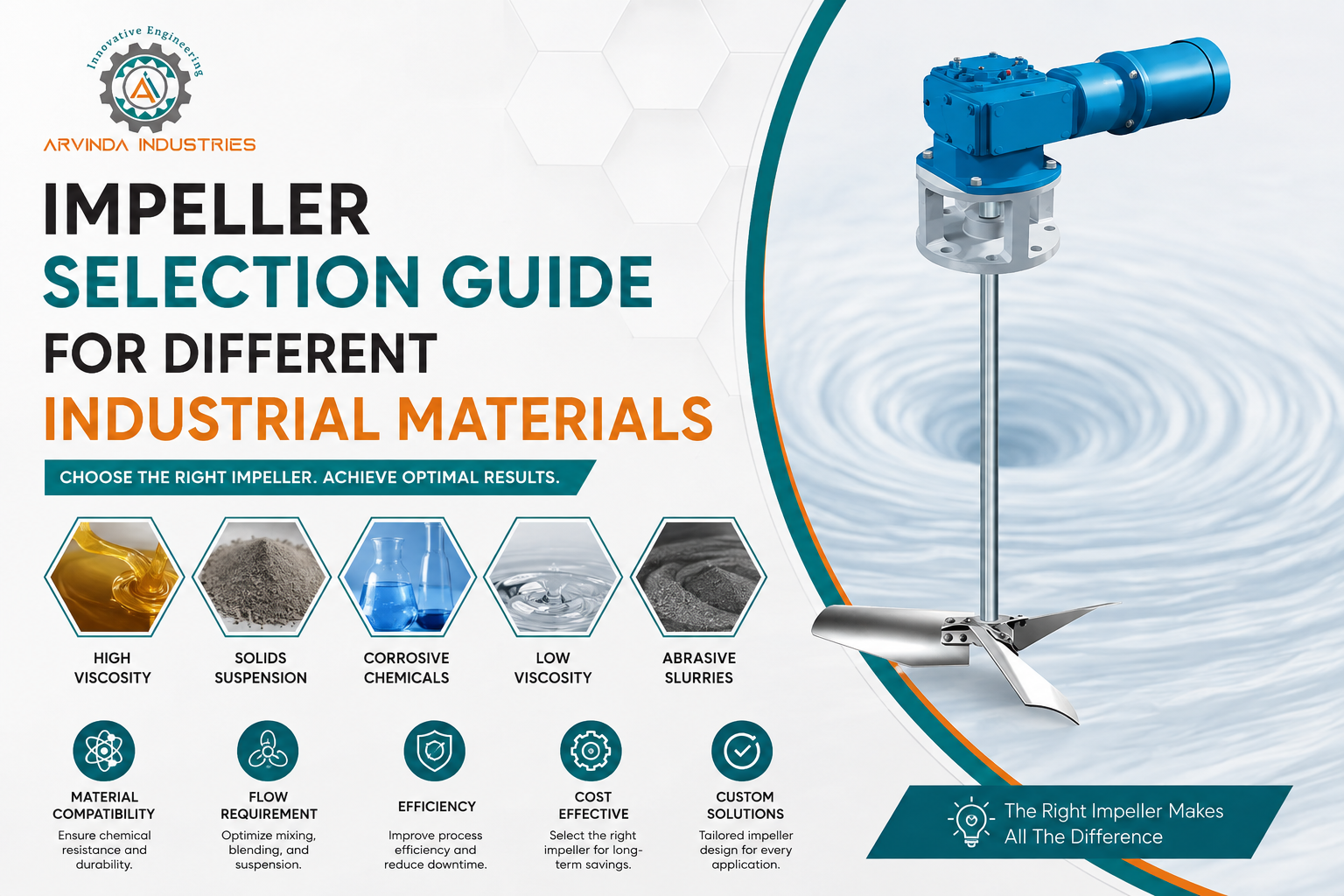
That is why impeller selection should begin with the material and the actual mixing requirement. Understanding viscosity, density, particle size, required flow, vessel conditions, and operating speed can help industries to achieve consistent results without unnecessary energy use. An experienced Impeller Manufacturer In India can help industries identify a suitable solution based on their specific mixing requirements.
Why Impeller Selection Matters in Industrial Mixing
A rotating mixing component creates movement inside the vessel. The shape, size, position, and operating speed influence how the material circulates. In case of an improper design, mixing may be performed by the machine for longer, and sometimes even unnecessarily.
A suitable design can support:
- Better material circulation
- More uniform mixing
- Controlled shear
- Improved solid suspension
- Reduced mixing time
- Consistent product quality
- Better energy utilisation
The objective is not simply to create more movement. It is to create the right movement according to the material and the desired process result.
Start With the Material
Before selecting a mixing arrangement, it is efficient to understand how the material behaves during processing. Various materials can behave differently under the same mixing conditions.
Liquids with Low and High Viscosity
Low-viscosity liquids flow freely and require effective circulation, while high-viscosity materials such as creams, pastes, and resins require controlled movement for thorough mixing.
Powders and Granules
Material size, density, moisture content, and flowability need to be taken into consideration for even material movement and blending.
Products Sensitive to Shear Force
Materials that may be influenced by excessive mechanical force may need gentle movement.
Common Impeller Designs
Different designs create different flow patterns and are suited to specific mixing requirements.
- Propeller: Suitable for low viscosity liquids and applications that require strong mixing.
- Paddle: Used for gentle mixing applications that do not need high shear.
- Turbine: Suitable for blending, dispersion, and solid suspension applications.
- Anchor: Widely used in processing highly viscous substances that require extensive movement.
- High-Shear: Applied for processes such as dispersion, emulsification, and de-agglomeration.
Important Factors Before Selection
- Material Viscosity
- Density
- Particle Size
- Mixing Objective
- Tank Dimensions
- Operating Speed
- Power Requirement
- Material of Construction
Selection for Different Industries
Industrial mixing requirements vary from one sector to another. A solution suitable for food processing may not be appropriate for a chemical application.
- Chemical Processing: Applications in liquid processing, chemical processing, suspensions, and formulations.
- Pharmaceutical Manufacturing: Cleanability, processing control, and product protection may be significant factors.
- Food Processing: Hygienic construction and consistent blending are common requirements.
- Paint and Coating Production: Different viscosities and dispersion requirements influence the equipment choice.
- Cosmetics Manufacturing: Creams, lotions, and similar products may require controlled and gentle movement.
- Water Treatment: Mixing is used for chemical dosing, suspension, and treatment processes.
- Polymer Processing: Higher-viscosity products may require suitable designs for effective material movement.
Common Selection Mistakes to Avoid
- Choosing a design based only on tank size
- Assuming higher speed always means better mixing
- Ignoring material viscosity and density
- Overlooking vessel dimensions and operating conditions
- Selecting construction material without considering the product
Conclusion
A successful mixing process starts with understanding the material and the required result. There is no single design that performs equally well across every application. Viscosity, density, particle size, vessel dimensions, operating speed, and construction material can all influence the final selection.
The right impeller should create the flow pattern the process actually needs. By considering these factors carefully, industries can achieve more consistent mixing, efficient operation, and dependable process performance.
Frequently Asked Questions (FAQs)
1. What is an impeller used for?
An impeller is a component that rotates in order to generate movement in a vessel. This process aids in the mixing, dispersing, or suspending of materials.
2. What kinds of materials are processed with industrial impellers?
Industrial impellers may be utilized for different types of materials like low-viscosity fluids, high-viscosity fluids, solids and liquid mixtures, powder and granular material.
3. How do I choose the right impeller for my process?
Selection depends on factors like viscosity, density, particle size, type of mixing, size of tank, speed, and power requirements.
4. Which impeller can be used for high viscosity materials?
High-viscosity materials like cream, paste, and resins need larger diameter impellers to move them efficiently.
5. Why choose Arvinda Industries for industrial impellers?
Arvinda Industries focuses on application-based industrial mixing solutions, considering the material characteristics and process requirements to provide a suitable impeller configuration.
