
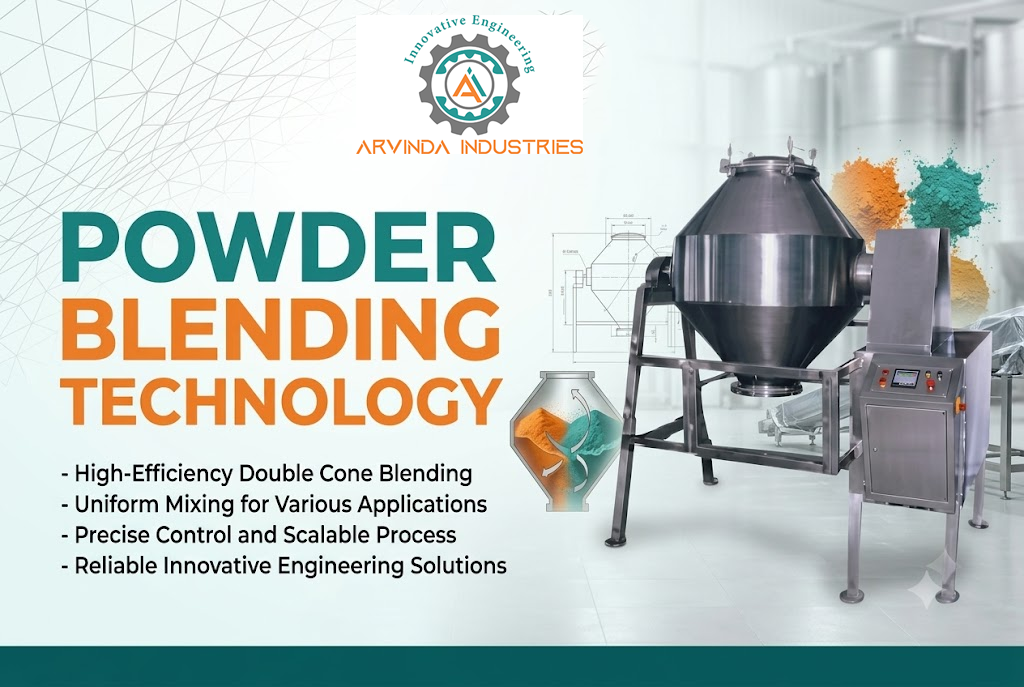
Arvind Industries manufactures mixing equipment for different industrial processes. As an industrial mixing equipment manufacturers, its range includes different types of mixers and agitators based on the material, quantity and mixing process. Understanding these factors makes it easier to select equipment that suits the actual production requirement.
Mixing Requirements Change with the Material
No two processing applications are exactly the same. Some ingredients flow easily and can be blended with gentle movement, while others may be cohesive, heavy or sensitive to excessive agitation. Moisture, particle size, density and flow behaviour can also affect how ingredients move inside a chamber.
Liquids present another set of conditions. Their viscosity, temperature and composition may determine the amount of agitation required. In some cases, solid particles also need to be distributed throughout a liquid and kept suspended during processing.
The Basics Behind Powder Blending
Powder mixing consists of the blending of two or more solid substances in order to achieve a certain degree of uniformity. It is a common practice in industries that involve mixing several different components before filling or compression.
Batch size is another consideration. A unit designed for a small production quantity may not be appropriate for a high-volume operation. The working capacity, loading pattern and operating conditions should all be considered before finalising the machinery.
Equipment Used for Dry Material Processing
Different blender designs are available because dry ingredients do not all behave in the same way.
A Double Cone Blender is a rotating vessel that produces a tumbling action. As the chamber rotates, the materials pass through various sections of the chamber, giving ingredients time to mix together. The procedure described can be recommended for cases of powder and granule applications which demand gentle handling.
An Octagonal Blender uses an octagonal-shaped vessel to create a different movement pattern. The changing geometry encourages the contents to tumble through the chamber during operation.
Ribbon Mixers follow another principle. Internal ribbon elements move ingredients through the vessel, creating circulation within the working area. They can be considered for applications where controlled movement of dry ingredients is required.
Arvind Industries manufactures a range of dry processing machinery, including Twin Shaft Ribbon Mixers, Vertical Ribbon Mixers, Continuous Ribbon Mixers and Continuous Paddle Mixers. Each design serves a different processing approach, allowing the selection to be based on the actual production requirement.
Understanding Agitators and Impellers
Agitators and impellers play an important role in many liquid-processing applications. An agitator typically includes a drive arrangement connected to a shaft, with an impeller positioned inside the vessel.
This makes impeller selection an important part of the overall design. A configuration suitable for a low-viscosity fluid may not deliver the same result with a highly viscous formulation.
Arvind Industries provides Industrial Agitators & Impellers for applications where controlled fluid movement is required. The appropriate arrangement can depend on factors such as viscosity, vessel dimensions, operating speed and the intended processing objective.
From Powder Blending to Liquid Processing
- Dry and liquid stages: Some production processes involve both dry blending and liquid mixing at different stages.
- Initial powder blending: Dry ingredients can be blended first to achieve even distribution.
- Further processing: The blended material may then be transferred to another vessel for the next production step.
- Solid-liquid mixing: Some applications require solid particles to be dispersed and maintained evenly within a liquid.
- Controlled movement: Liquid processing requires suitable agitation rather than the tumbling action used for dry materials.
For this reason, working with experienced Industrial Mixing Equipment Manufacturers can help businesses assess the complete process and identify machinery that fits the required production method.
Conclusion
Powder blending and liquid processing may fall under the same broad category of material processing, but the principles involved can be quite different. Dry ingredients often require controlled tumbling or ribbon movement, whereas fluids may need carefully planned agitation and circulation.
A clear understanding of the process before purchasing machinery can help create a more suitable production arrangement. Arvind Industries, as one of the experienced industrial mixing equipment manufacturers, offers a range of solutions for powder and liquid processing applications across multiple industries.
Frequently Asked Questions (FAQs)
1. What is industrial mixing equipment?
Machinery used to blend powders, granules, liquids and other materials uniformly.
2. Which machines are used for powder blending?
Double Cone Blenders, Octagonal Blenders and Ribbon Mixers are commonly used.
3. What equipment is used for liquid mixing?
Industrial Agitators and Impellers are used for controlled liquid movement.
